
Chronic disease management has always depended on two things: accurate data and timely intervention. For decades, both required a clinical setting — scheduled appointments, lab draws, and reactive adjustments after symptoms had already escalated. Wearable medical devices are changing that equation. Continuous glucose monitors, cardiac patches, remote blood pressure cuffs, and implantable-adjacent sensors are moving real-time physiological data from hospital corridors into patients’ daily lives.
The shift is not incremental. It is restructuring how clinicians think about monitoring, how patients experience their conditions, and how health systems allocate resources across prevention and acute care.
What Wearable Medical Devices Actually Measure Today
The category is broader than most people assume. Consumer fitness trackers occupy one end of the spectrum, capturing general activity and estimated heart rate with limited clinical precision. Cleared medical-grade wearables operate under a different standard entirely — FDA clearance or approval, validated accuracy thresholds, and defined intended uses tied to specific conditions.
Continuous glucose monitors (CGMs) measure interstitial glucose levels every one to five minutes, generating a dynamic picture of glycemic variability that a twice-daily finger stick simply cannot provide. For people managing type 1 diabetes, that granularity is the difference between reactive corrections and proactive pattern recognition. Cardiac event monitors — worn for 14 to 30 days — detect arrhythmias that would never surface during a 12-lead ECG captured over 10 seconds in a clinic. Wearable blood pressure monitors cleared for ambulatory use record readings across a full 24-hour cycle, capturing the nocturnal dipping patterns that predict cardiovascular risk more reliably than office measurements alone.
The distinction between consumer-grade and medical-grade matters enormously when clinical decisions depend on the data. A device that estimates SpO2 within plus or minus four percentage points is adequate for trend awareness; it is not adequate for titrating supplemental oxygen in a COPD patient.
Continuous Glucose Monitoring and Diabetes Management
CGM technology illustrates the practical ceiling — and the practical friction — of wearable diagnostics better than almost any other device category.
The clinical evidence is substantial. Studies published in journals including The New England Journal of Medicine have demonstrated that real-time CGM use in type 1 diabetes reduces time spent in hypoglycemia and improves time-in-range metrics compared to self-monitored blood glucose alone. The FDA’s expanded clearance of CGMs for non-insulin-using type 2 patients in recent years reflects growing evidence that glycemic insight benefits a far wider population than originally targeted.
The practical trade-off is cost. Prescription CGM systems run approximately $100 to $150 per month for sensors after insurance, and coverage varies significantly by plan type and diagnosis code. For a type 2 patient not on insulin, out-of-pocket costs can reach $200 or more monthly without employer-sponsored coverage. Generic finger-stick monitoring, by contrast, costs roughly $20 to $40 per month. The accuracy gap is real, but so is the financial barrier — and clinicians increasingly face the question of whether a less comprehensive monitoring approach that a patient will actually sustain outperforms a superior technology the patient abandons after three months due to expense.
Cardiac Monitoring Beyond the Annual ECG
Intermittent arrhythmias present a diagnostic problem that scheduled appointments structurally cannot solve. Atrial fibrillation, in particular, may occur in brief, asymptomatic episodes that escape detection for years while silently elevating stroke risk. Extended cardiac event monitoring patches — worn continuously for up to 30 days — have become a standard diagnostic tool for unexplained palpitations, syncope, and cryptogenic stroke workups.
The clinical yield difference is significant. Studies comparing 24-hour Holter monitoring to 14-day patch monitors consistently show detection rates for clinically actionable arrhythmias that are three to four times higher with the extended wear period. That diagnostic lift comes at a cost: 14-day patch systems typically bill at $300 to $700 depending on analysis services, compared to roughly $150 to $250 for traditional Holter monitoring.
For patients who have already experienced a stroke of undetermined origin, the calculus strongly favors extended monitoring. For someone with occasional, low-frequency palpitations and no other risk factors, starting with shorter-duration monitoring is a reasonable first step — particularly when the clinical threshold for intervention would not change regardless of which arrhythmia type is identified.
Remote Patient Monitoring and the Shift Toward Proactive Care
Wearable devices become most powerful when they feed into structured remote patient monitoring (RPM) programs rather than operating as standalone data streams. RPM programs use cellular-connected devices — blood pressure cuffs, weight scales, pulse oximeters, CGMs — to transmit readings directly to care teams, who review data and intervene before a patient deteriorates to the point of requiring an ED visit or hospitalization.
The Centers for Medicare and Medicaid Services established reimbursement pathways for RPM under specific CPT codes beginning in 2019, making these programs economically viable for qualifying practices and patients. At minimum, CMS requires 16 days of data collection per 30-day period and at least one interactive communication between provider and patient monthly to bill for ongoing monitoring services.
The challenge is patient engagement, not technology. RPM programs that supply devices without adequate onboarding see adherence drop sharply after the first four to six weeks. Programs that pair device distribution with structured check-in calls at two weeks and 30 days consistently maintain higher data transmission rates through the 90-day mark.
Where Wearables Fall Short and What Patients Misunderstand
The expanding category of medical wearables has created a parallel problem: conflation of consumer monitoring with clinical-grade assessment. Smartwatch ECG features, for instance, can detect atrial fibrillation with reasonable sensitivity in validated populations, but their positive predictive value in younger, lower-risk users is considerably lower — generating anxiety and downstream testing without proportionate clinical benefit.
Device categories outside cardiology and metabolic monitoring carry similar nuances. Wearable pain management devices using transcutaneous electrical nerve stimulation, sleep-staging wearables, and even advanced hearing aids have demonstrated meaningful utility in their respective populations, but the strength of evidence varies substantially across conditions and individuals.
The most common mistake patients make is treating an alert or a trend line as a diagnosis. Wearable data narrows diagnostic probability; it rarely eliminates the need for clinical interpretation. Sharing complete device data — not just a screenshot of one alarming reading — with a clinician enables the kind of pattern analysis that justifies the technology’s cost and inconvenience.
Choosing the Right Device for a Specific Condition
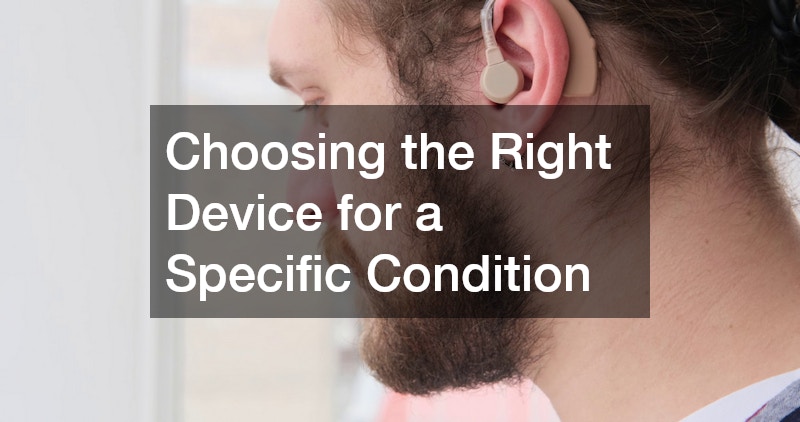
Not every chronic condition benefits equally from wearable monitoring, and not every patient benefits equally from the same device within a given condition category. The decision framework should account for three variables: clinical evidence strength for that device-condition pair, realistic patient adherence over six or more months, and total cost including consumables.
- Before committing to a CGM system, confirm that your specific insurance plan covers the prescribed device model — formulary restrictions can mean a clinically equivalent sensor costs $0 versus $150 per month depending on brand.
- For cardiac monitoring, ask the ordering clinician whether the diagnostic question requires continuous beat-to-beat recording or event-triggered capture, since the answer determines whether a patch monitor or an implantable loop recorder is the appropriate tool.
- If enrolling in an RPM program, ask within the first appointment how many days of transmitted data are required per month to maintain coverage and what the clinical team’s response protocol is when readings exceed threshold values.
The technology is only as useful as the care pathway built around it.
Making the Decision to Start Wearable Monitoring
Starting wearable medical monitoring is not primarily a technology decision — it is a care coordination decision. The device is a tool; the value comes from how the data it generates gets used. Before investing in hardware or committing to a monthly consumable cost, patients managing chronic conditions should ask their care team two questions: what clinical decision will this data change, and who is responsible for reviewing it and acting on it? If neither question has a clear answer, the device is likely to generate data that accumulates without improving outcomes. When both have clear answers, wearable monitoring can meaningfully compress the gap between symptom onset and clinical response.
